
Centrifugal Fan Working Principle and What It Means for HVAC Selection
Introduction: Why Understanding Centrifugal Fan Working Principle Matters
In modern HVAC and industrial ventilation systems, choosing the right fan directly affects system performance, energy consumption, and long-term operating costs. Among various ventilation equipment, centrifugal fans are widely used in factories, commercial buildings, laboratories, chemical plants, and industrial air handling systems due to their high efficiency and stable airflow performance.
Before selecting an industrial centrifugal fan, understanding the centrifugal fan working principle helps engineers and buyers choose the correct fan type according to airflow requirements, pressure conditions, installation environment, and energy-saving goals.
As a professional HVAC equipment manufacturer, Shunda HVAC provides customized centrifugal fan solutions for global customers, including Southeast Asia, the Middle East, and other industrial markets.
How Does a Centrifugal Fan Work?
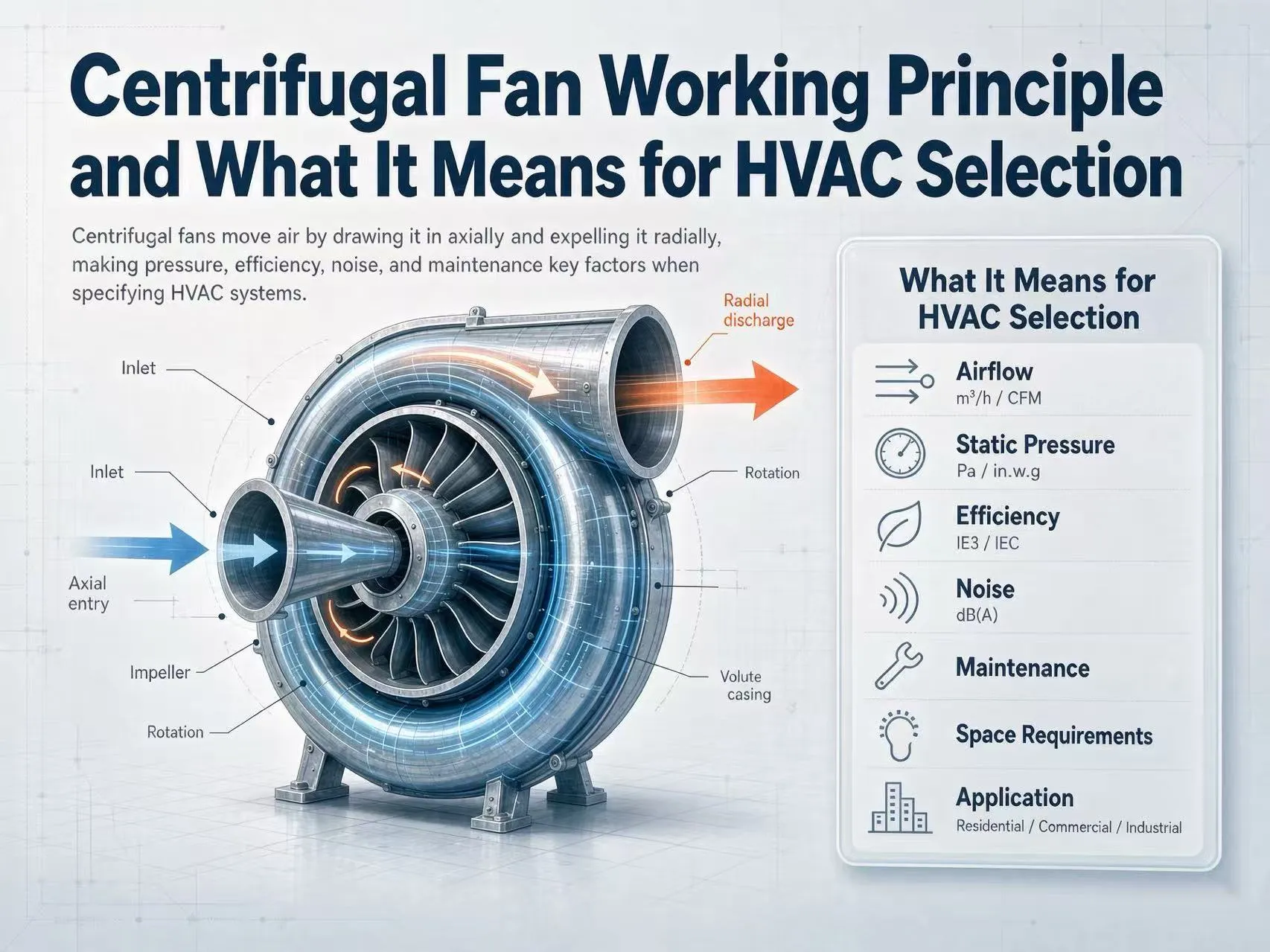
A centrifugal fan works by converting the mechanical energy from a motor into airflow through centrifugal force.
Unlike axial fans that move air in a straight direction, centrifugal fans change the direction of airflow. Air enters the fan through the inlet, rotates with the impeller, and is pushed outward by centrifugal force before leaving through the outlet at a higher pressure.
The basic working process includes three steps:
1. Air Intake
When the motor starts, the impeller begins rotating at high speed. Negative pressure is created at the fan inlet, allowing surrounding air to enter the centrifugal fan housing.
2. Air Acceleration by the Impeller
The rotating blades transfer energy to the air. The centrifugal force generated by the impeller increases the air velocity and pressure.
The design of the impeller blades, rotation speed, and diameter directly influence fan performance.
3. Pressure Conversion and Air Discharge
Inside the fan casing, part of the kinetic energy is converted into static pressure. The compressed air is then discharged through the outlet and delivered into the HVAC duct system.
This continuous process enables centrifugal fans to provide stable airflow even under high resistance conditions.
Main Components of an Industrial Centrifugal Fan
Understanding the structure of a centrifugal fan helps HVAC engineers make better equipment selections.
1. Impeller
The impeller is the core component responsible for generating airflow. Different blade designs provide different performance characteristics:
Forward curved blades: Suitable for low-pressure and high airflow applications
Backward curved blades: Higher efficiency and energy saving
Radial blades: Suitable for industrial applications with dust and high-pressure requirements
2. Motor
The motor provides power to rotate the impeller. Energy-efficient motors can significantly reduce operating costs in large HVAC systems.
3. Fan Housing
The spiral-shaped casing guides airflow and converts velocity into pressure, improving fan efficiency.
4. Inlet and Outlet
Proper inlet and outlet design reduces airflow turbulence and improves overall system performance.
Centrifugal Fan vs Axial Fan: Which One Should You Choose?
A common question from HVAC buyers is: Should I choose a centrifugal fan or an axial fan?
The answer depends on the application.
Feature | Centrifugal Fan | Axial Fan |
|---|---|---|
Airflow Direction | Changes direction by 90° | Straight airflow |
Pressure Capability | High pressure | Low to medium pressure |
Duct System | Excellent for long duct systems | Suitable for open ventilation |
Noise Control | Generally lower noise | Higher airflow noise |
Applications | HVAC systems, factories, filtration systems | Cooling, exhaust ventilation |
For applications requiring long-distance air transportation, filtration resistance, or stable pressure, an industrial centrifugal fan is usually the better choice.
How to Select the Right Centrifugal Fan for HVAC Systems?
Selecting the correct centrifugal fan requires consideration of several important factors.
1. Airflow Requirement (m³/h)
The first step is determining the required airflow volume. An oversized fan increases energy consumption, while an undersized fan cannot meet ventilation requirements.
2. Static Pressure
HVAC systems with long ducts, filters, heat exchangers, or ventilation resistance require fans with higher pressure capability.
3. Operating Environment
Different environments require different materials:
Normal environments: Carbon steel centrifugal fans
Corrosive environments: FRP centrifugal fans
High-temperature applications: High-temperature resistant fans
Dusty industrial environments: Heavy-duty centrifugal blowers
For chemical plants, wastewater treatment facilities, and corrosive industrial applications, FRP centrifugal fans provide excellent corrosion resistance and longer service life.
4. Energy Efficiency
A high-efficiency centrifugal fan can reduce electricity consumption and operating costs, especially in large industrial ventilation projects.
Selecting the right impeller design, motor power, and control method helps achieve better energy performance.
Why Choose Shunda HVAC Centrifugal Fans?
Shunda HVAC specializes in manufacturing customized industrial ventilation solutions for global customers.
Our centrifugal fan advantages include:
✔ High airflow efficiency and stable pressure performance
✔ Customized design according to project requirements
✔ FRP and corrosion-resistant options available
✔ Suitable for HVAC, industrial ventilation, and exhaust systems
✔ Factory direct supply with competitive pricing
✔ Professional technical support for international projects
Our products are widely applied in factories, commercial buildings, workshops, chemical industries, and large ventilation projects.
Applications of Centrifugal Fans in HVAC and Industry
Centrifugal fans are commonly used in:
Industrial HVAC ventilation systems
Factory exhaust systems
Chemical processing plants
Food processing facilities
Clean rooms and laboratories
Waste gas treatment systems
Commercial building air handling units
Energy-saving ventilation projects
Their reliable performance makes them one of the most important air-moving devices in modern HVAC engineering.
Conclusion: Correct Fan Selection Improves HVAC Performance
Understanding the centrifugal fan working principle allows engineers and buyers to make better HVAC equipment decisions. The correct centrifugal fan selection improves airflow stability, reduces energy costs, and extends system service life.
If you are looking for a reliable industrial centrifugal fan manufacturer, Shunda HVAC provides customized solutions based on airflow, pressure, materials, and application requirements.
Contact Shunda HVAC today for a professional centrifugal fan quotation and technical solution for your project.